MY JOURNEY


For over 30 years I have been creating HOLOGRAMS for exhibitions, published products, and personal or custom‑made creations.

How do you become a hologram creator?

My job is a true passion. My journey is marked by stereoscopic processes with sometimes complex names, such as autostereogram, anaglyph, stereoscope or lenticular arrays.
I will introduce them to you by sharing my experience.

The adventure begins in 1994. At the age of 25, I was a computer scientist at the French Ministry of Defense. I was then discovering the “Magic Eye” book series, which featured strange images... These were autostereograms, which require eye gymnastics to perceive a hidden 3D image.

Already very interested in 3D images, but not yet passionate about them, I was a member of the Stéréo-Club Français, which that year was organizing the International 3D Image Congress under the aegis of the ISU (International Stereoscopic Union).

Together with Franck CHOPIN, a friend and colleague, we developed software to create our own autostereograms. We printed them in large format to exhibit them at the Congress. It was a resounding success, and we were even lucky enough to get a nice article in a magazine aimed at communications agencies (BAT).

The first orders poured in. I asked my employer for a leave of absence and founded the company MEDIA RELIEF, first as a sole proprietorship, then as a SARL (limited liability company) in 1997 when Franck CHOPIN joined me in the adventure.
Autostéréogrammes

The autostereograms

Eye gymnastics to discover a 3D image

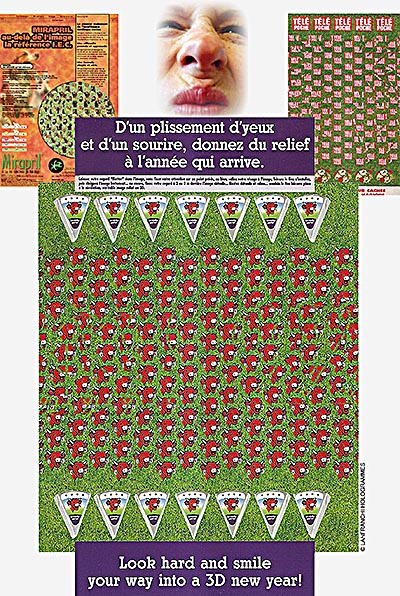
In 1994 I founded the company MEDIA RELIEF, riding the wave of autostereograms popularized by the “Magic Eye” book series. These very special images let you discover a hidden 3D scene, visible only at the cost of eye gymnastics.

The playful and mysterious aspect then appealed to our first clients:

  • PepsiCola, Vache qui Rit... (Greeting card)
  • La Bred, Maître Kanter... (Flyer)
  • Télépoche (Prize contest)
  • ...

MY FAVORITE MEMORY

It is also the most rewarding one: the collaboration with Olivier LAPIDUS on an autostereogram motif used in the creation of a Haute Couture dress from his spring-summer 1995 collection.

TUTORIAL
> How to view an autostereogram
Autostéréogrammes

The anaglyphs

Put on your two-color glasses!

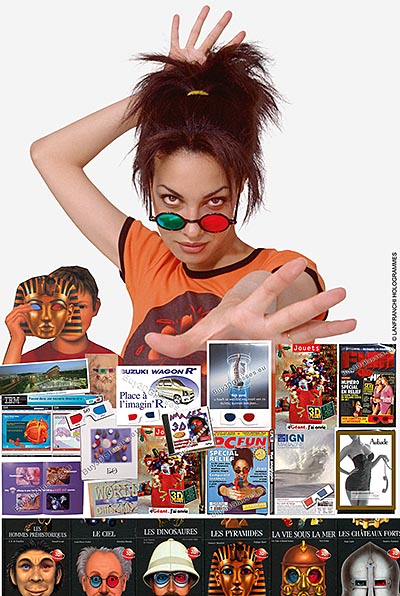
It is probably the most popular stereoscopic process: the one with the famous two-color glasses. Although it seems rather basic and of mediocre quality at first glance, this process taught me a great deal about color.

MEDIA RELIEF gave this process a new lease on life by improving the quality of printed anaglyphs:

  • Aubade, EO Conseil... (Greeting card)
  • FHM, PC FUN, IGN... (Press)
  • Suzuki, JPG... (Sales brochure)
  • Gillette... (Press kit)
  • Géant Casino (Christmas 1996 catalog printed in 8 million copies)

MY FAVORITE MEMORY

We had the pleasure of working with Hachette Jeunesse on a wonderful project: the “3D EXPLORER” collection (co-published in 6 languages worldwide). Each book features 6 double-page illustrations for which we handled the 3D conversion; and the glasses are replaced by a mask!

> See an illustration from the 3D EXPLORER collection

Autostéréogrammes

The stereoscopes

A device similar to binoculars

A stereoscope, also called a stereoscopic viewer, merges the left and right images of a stereoscopic pair to recreate a single 3D image: it is the ancestor of today's VR headsets.

While the first 19th-century models looked like wooden boxes, those marketed by Jean-Michel BOLLIER in the 1990s featured an attractive, customizable design: perfect for turning them into a fine communication tool.

Our ability to convert existing visuals to 3D naturally led us, from 1998 onward, to work with him to market his product. It was an opportunity to constantly improve our tools and our sensitivity to “sculpting” (that is, converting to 3D) any type of image supplied by clients.

MY FAVORITE MEMORY

> The 3D conversion of the PEUGEOT 206 WRC

Autostéréogrammes

The lenticular arrays

The 3D effect in natural viewing, like a hologram

The 3D effect in natural viewing, like a hologram

From 2000 on, our research gradually focused on a solution capable of rendering the 3D effect immediately, without glasses or eye gymnastics.

In 2006 MEDIA RELIEF entered into a partnership with the Musée RODIN to publish a collection of 3D postcards depicting the sculptor's emblematic works.

Starting in 2008, mastery of the production of large format prints made new applications possible, which appealed to both:

MY FAVORITE MEMORY

> The collaboration with the Musée du Luxembourg.

In 2012 the company MEDIA RELIEF changed its name
and became LANFRANCHI hologrammes

For a long time, I used to correct my clients when they spoke of holograms. I would explain to them that “true holograms are based on the interference of two light beams, whereas lenticular arrays use cylindrical optical lenses that act as an optical selector”.

But I eventually realized that in everyday language, a hologram is simply a 3D image that you view without glasses!

This is how MEDIA RELIEF becomes
LANFRANCHI hologrammes

This is how MEDIA RELIEF becomes LANFRANCHI hologrammes.

Academy Award Trophy

FIRST PRIZE

That same year, the company was rewarded by winning the LENSTAR LENTICULAR PRINTING AWARD competition with the print of the “Beau Dieu of Amiens Cathedral” produced in collaboration with the company Art Graphique & Patrimoine.

> View the print <


Hommage

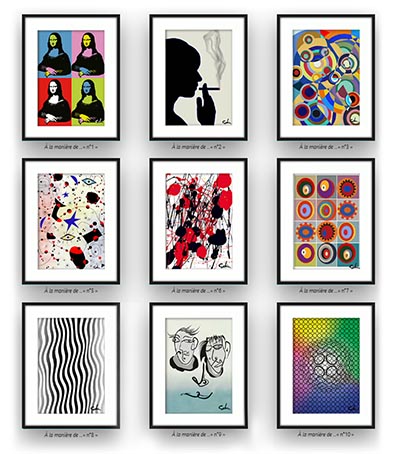
The “In the Style of” collection

First exhibition


Artistic approach

Between personal experiments
and artistic collaborations

Between personal experiments
and artistic collaborations

In 2008 the manager of the Musée du Luxembourg shop asked me to design a collection for the “De Miró à Warhol” exhibition, drawing inspiration from the great artists of modern art: what a wonderful challenge!

Through different styles, I set out to experiment and play with light, colors, movement, perspectives, volumes, depths and pop-out effects.

This fascinating research opened a door to a world of infinite possibilities, blending technical skill and creativity, which I have never stopped exploring since.

COLLABORATIONS WITH ARTISTS

A growing number of artists are interested in this technology as a way to give a new dimension to their works. Each brings their own universe, unique vision, aspirations and questions.

My role is to adapt by putting my expertise at their service. These exchanges are particularly stimulating because they often generate technical and creative challenges that push us to rethink the limits of what is possible.

It is always a great satisfaction to see how this technology can adapt and reinvent itself to serve each artist's aspirations. In this way, these collaborations nourish my practice as much as they enrich theirs.